


British Revenue System
The British Revenue System marked a significant transformation in India’s agrarian administration. Land revenue became the primary source of income for the colonial government, and therefore, systematic mechanisms were introduced to ensure regular and maximized collection.
Unlike the Mughal system, which emphasized administrative hierarchy and agricultural productivity, the British model focused primarily on fiscal stability and contractual revenue arrangements. This shift fundamentally altered land ownership patterns, tenant rights, and the relationship between the state and cultivators.
Major British Revenue Systems
Permanent Settlement
Introduced by Lord Cornwallis in Bengal, this system fixed land revenue permanently and recognized Zamindars as landowners.
- Revenue permanently fixed
- Zamindars became proprietors
- No ownership security for peasants
- Rigid revenue demand
Ryotwari System
Implemented in Madras and Bombay, this system established direct settlement between the government and cultivators.
- Direct settlement with farmers
- No intermediaries
- Periodic reassessment
- Heavy revenue burden
Mahalwari System
Introduced in North India, this system fixed revenue at the village (mahal) level with collective responsibility.
- Village collective responsibility
- Periodic revision of revenue
- Based on productivity estimates
- Administrative instability
Comparison of Revenue Systems
| Feature | Permanent | Ryotwari | Mahalwari |
|---|---|---|---|
| Introduced In | Bengal | Madras & Bombay | North India |
| Ownership | Zamindar | Cultivator | Village Community |
| Revenue Type | Fixed | Periodic | Periodic |
| Intermediary | Yes | No | Village Body |
Impact on Indian Land Law
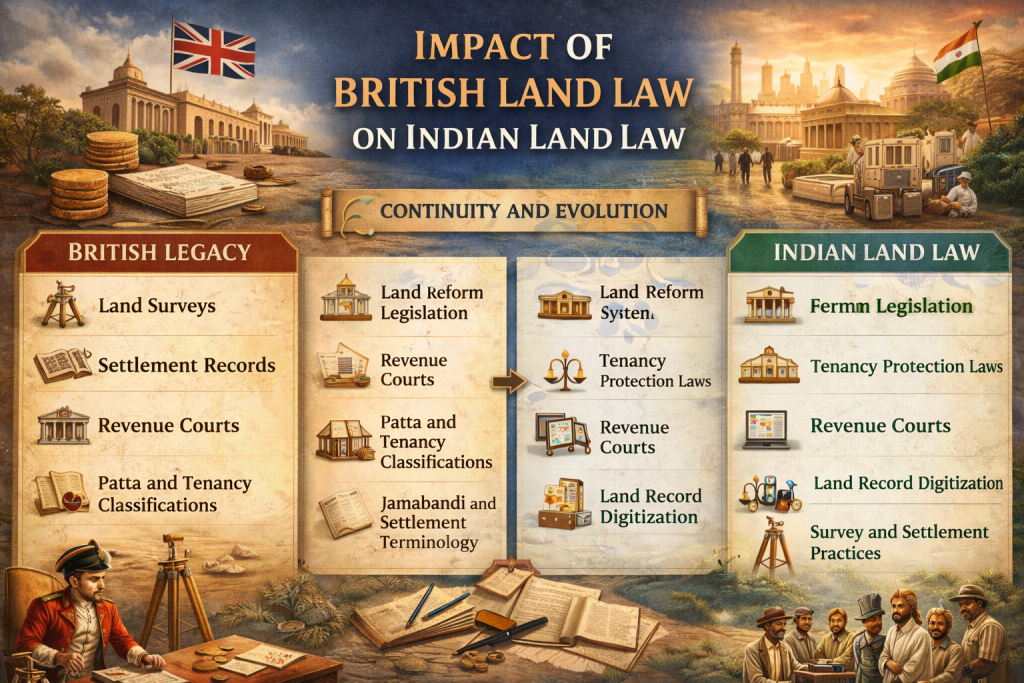
The British revenue framework shaped modern Indian land legislation. Concepts such as land ownership records, settlement surveys, tenancy protection, and revenue courts evolved from colonial administration.
Even today, many land revenue terminologies and administrative practices trace their origin to British policies.